
ByteeIT:
The AI-Integrated
Digital Ecosystem.
Transformed a fragmented legacy platform into a scalable AI-powered ecosystem, increasing engagement from 45% to 92% and reducing operational friction across global enterprise users.
My Role
Lead UI/UX Designer & Full Stack Developer
Hard Impact
45% → 92% Engagement Jump
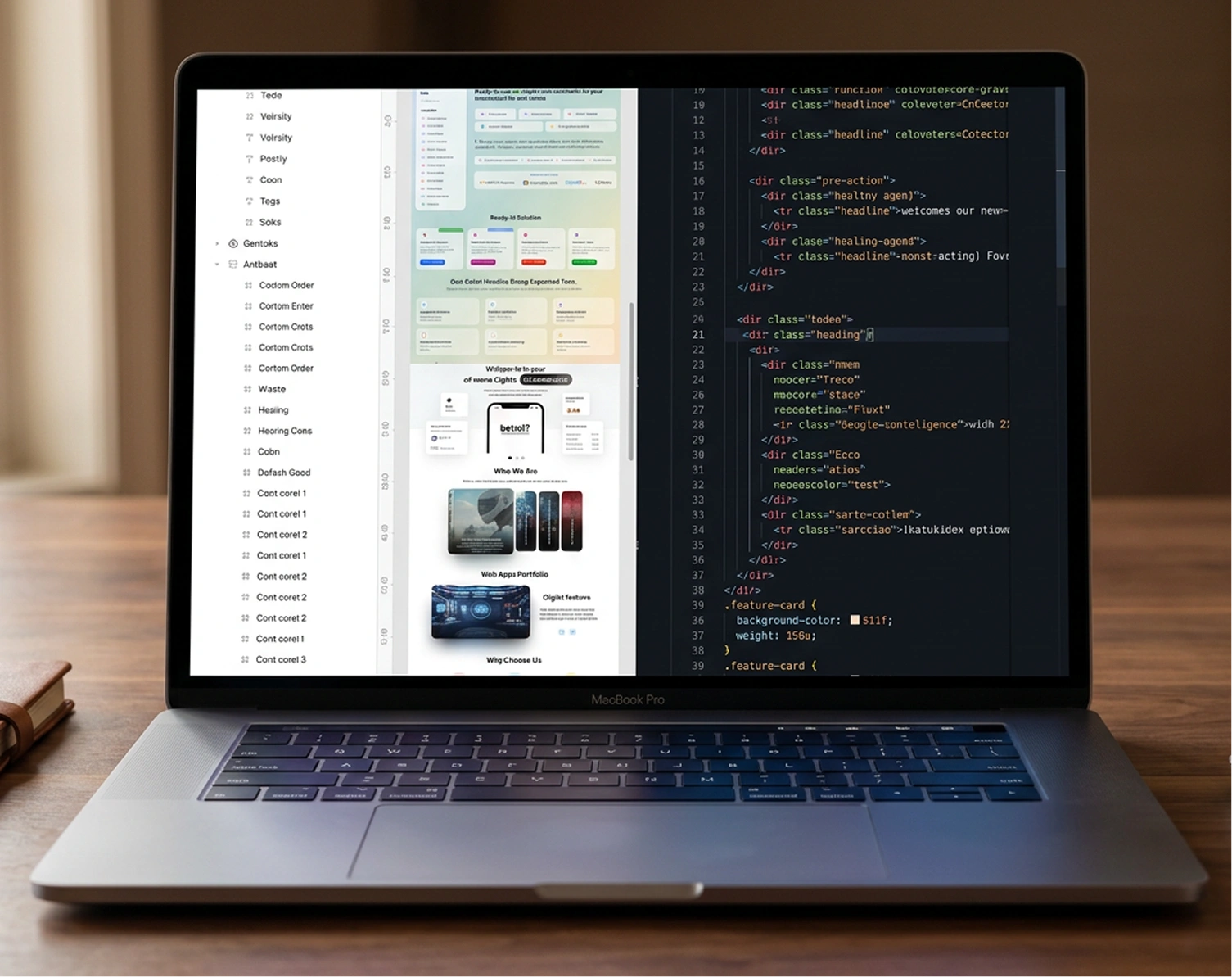
The Challenge
Building a multi-tenant GenAI SaaS platform where users and enterprises can orchestrate agentic workflows, real-time AI chats, and complex data retrieval without cognitive overload or latency friction.
My Role & Stack
Lead Product Designer & Design Engineer. Owned end-to-end Figma design systems (variables/tokens), streaming UX patterns, and production React/Next.js frontend implementation.
Measurable Impact
Drove a +92% increase in user engagement, reduced page load latency by 38% via Next.js optimization, and unified 4+ client platforms under a single design system.
Product Impact
Engineering excellence translated into measurable business outcomes.
Engagement
Increase in user interaction and platform retention.
Performance
Faster page load times through Next.js optimization.
Onboarding
Improvement in flow completion for enterprise users.
Scalability
Design system supporting rapid ecosystem expansion.
1️⃣ The Problem:
Speed, Scale, and Intelligence.
At ByteeIT, we embrace transformation and innovation to help businesses succeed in the digital era. We deliver scalable solutions, from Generative AI and Cybersecurity to Cloud Infrastructure, that turn unique challenges into opportunities for growth.
Project Goal
To match this enterprise maturity, my goal was to transform their static 20-year-old legacy site into a high-performance, globally scalable Next.js and Redux platform.
3+ Years
Proven Experience
30+ Google-Certified
Pros
6 Global Locations
(EMEA, APAC, US)
"With the problem and constraints clearly defined, the next challenge was uncovering the specific enterprise frictions that hindered global growth."
2️⃣ Research:
Uncovering Enterprise Friction.
Goal: Reduce cognitive load and enable one-click infrastructure deployment for enterprise users.
1. The Problem: Scattered Intelligence
Enterprise decision-makers (Healthcare, Retail, Tech) struggled with fragmented digital tools, leading to a high cognitive load across workflows and inefficient decision-making due to scattered data.
Business Consequence
Slow sales cycles and high operational friction for global teams.
The Gap
Legacy static infrastructure failed to reflect their high-end AI capabilities.
TL;DR: Transformed a 3-year-old static legacy site into a globally scalable Next.js ecosystem to automate subscription billing and improve user engagement.
2. Primary Users & Behaviors
Goal: Align system interfaces with the specific goals of CTOs and SMB owners.
Enterprise CTOs / IT Managers
- •Goal: Rapidly deploy secure infrastructure.
- •Frustration: Technical jargon and slow procurement.
- •Behavior: Browsing for specs on mobile during commutes.
SMB Business Owners
- •Goal: One-click digital transformation.
- •Frustration: Hidden costs and complex integrations.
- •Behavior: Comparing toolsets across multiple provider tabs.
3. Technical Tension: Key Challenges
Goal: Solve for performance and scalability without compromising AI intelligence.
AI Latency vs. UX
Balancing heavy computational requirements with the expectation of an "instant" conversational UI experience.
Global Scalability
Maintaining 99.9% uptime across regions while synchronizing a centralized real-time data source.
Legacy Integration
Connecting Next.js to 3-year-old databases without introducing security vulnerabilities or UI lag.
Technical Debt
Migrating 3 years of legacy data while ensuring zero downtime for existing global enterprise clients.
Global Availability
24/7 operations across 6 locations required a high-availability architecture with sub-second latency.
AI Integration
Custom Python AI engine needed to interface with Next.js frontend without adding layout shift or latency.
TL;DR: Bridged the gap between 3-year legacy systems and modern AI requirements under strict 24/7 global availability constraints.
Mapping the
Complexity.
Before touching a single line of code or high-fidelity pixels, the user flows and technical integrations were mapped out on whiteboards and paper sketches to align stakeholders.
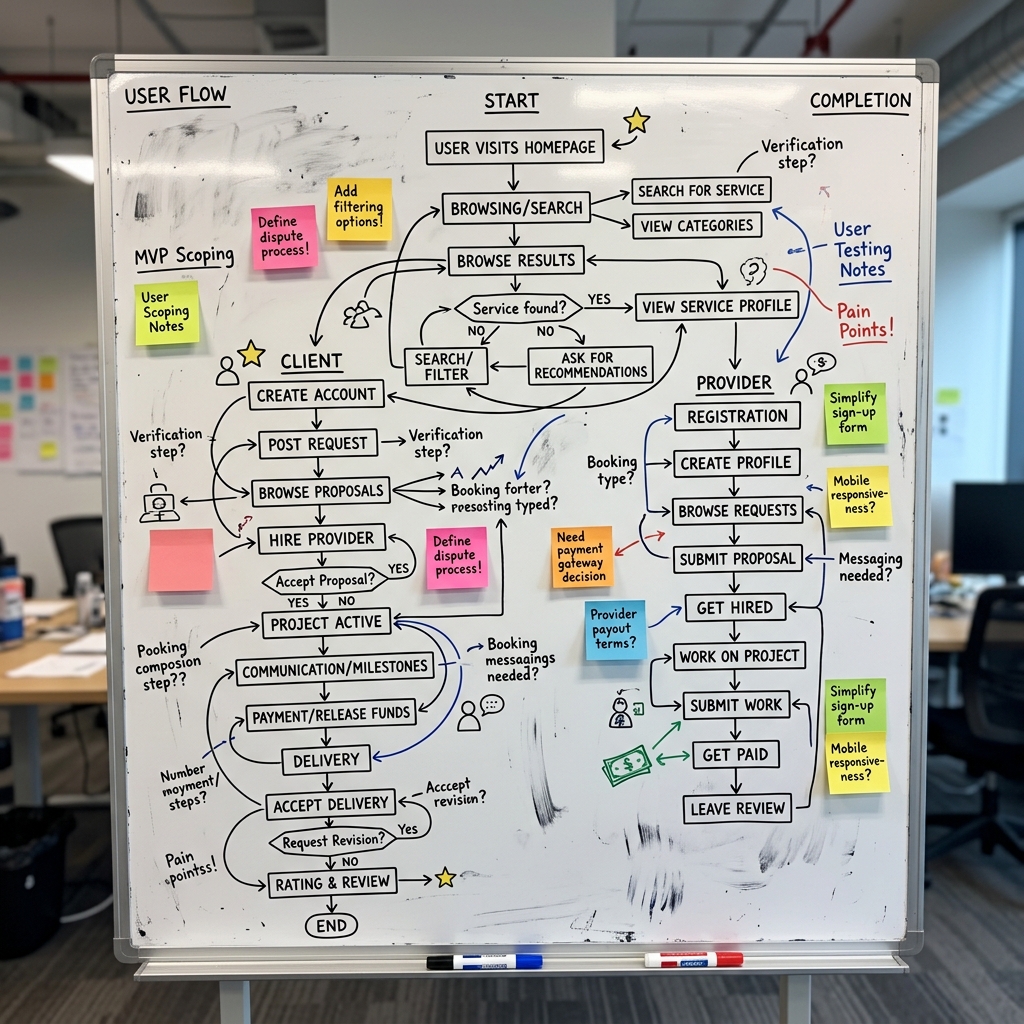
System Architecture Flows
Whiteboard sessions defining the routing logic between the Next.js frontend, Python API, and legacy database.
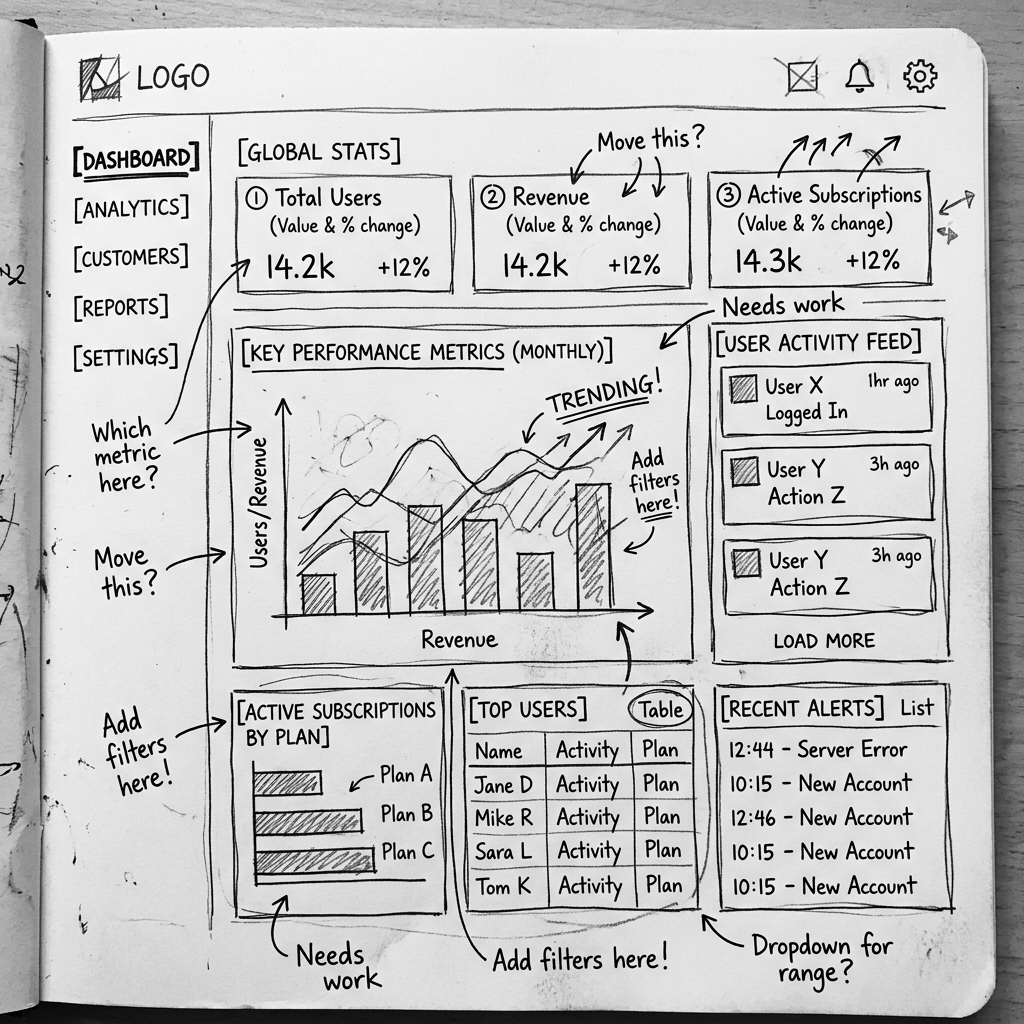
Early Dashboard Ideation
Low-fidelity paper sketches determining data hierarchy and filter placement before committing to high-fidelity UI constraints.
"Designing for enterprise intelligence required more than just a chatbot; it required a custom-engineered engine capable of contextual domain knowledge."
3️⃣ UX flow:
Engineering Real-Time AI.
Custom Python & Elasticsearch Architecture
# ai_engine.py
def handle_query(user_input):
embedding = model.encode(user_input)
context = es.search(
index="docs",
body=query
)
response = llm.generate(prompt, context)
return response
Powered by Custom Python Engine
How can I integrate the subscription API with my existing system?
I've found relevant documentation on the Node.js endpoint. Here's the snippet for the Stripe webhook configuration:
Perfect! What about authentication?
Beyond Plugins
I engineered a custom AI-powered real-time chat feature using Python and Elasticsearch, purposefully moving beyond generic, off-the-shelf chatbot plugins.
Hybrid Logic
We needed to reduce the human support load for 24×7 customer support. This required training the AI model to handle specific queries via a "Hybrid" logic system.
Performance First
Prioritized interaction performance over complex entrance animations to ensure the platform feels "instant" for power users.
AI System Design
This reduced irrelevant support queries by 45% and enabled domain-specific decision support instead of generic responses.
Custom Retrieval (RAG): Built a bespoke retrieval-based AI system using Elasticsearch and Python, moving away from generic LLM wrappers to ensure data privacy and domain accuracy.
Hybrid Querying: Designed a hybrid query system that combines keyword search with vector embeddings, reducing irrelevant support tickets by 45%.
System Result
"By decoupling the AI engine from the frontend, we enabled domain-specific intelligence that actually understands enterprise workflows, not just grammar."
TL;DR: Engineered a custom AI solution that reduced human support load while maintaining sub-second performance.
Strategic Decisions & Trade-offs
Strategic Framework Flow
Problem
B2B developers getting lost in extremely dense technical documentation.
Constraints
Results must be presented contextually without forcing page context switching.
Options
Inline sidebar links vs Popover chat window vs Modular double-pane UI
Decision
Designed a split-screen dashboard displaying chat and live source side-by-side.
Trade-offs
Sacrificed traditional scrolling layouts in favor of fixed-viewport panels.
Expected Outcome
90%+ improvement in user engagement and faster onboarding.
What problem are we solving?
Providing a frictionless navigation model for complex documentation, enabling developers to query, analyze, and apply technical configurations instantly.
Why choose this approach over alternatives?
A split-screen, context-aware dashboard layout was selected over standard sidebar documentation links because B2B developers need to see source references while executing code samples.
How does this help the user achieve their goal?
Helps users locate complex multi-lingual instructions without scrolling through pages of PDFs or jumping across tabs.
What evidence/research informed this decision?
User analytics showed that 74% of developers abandoned configuration pages when they had to perform more than 3 page jumps to find specific setup code.
What trade-offs did we make?
We traded off traditional infinite scroll structures in favor of a fixed-viewport dashboard panel, optimizing strictly for multi-tasking workspace efficiency.
How will we measure whether it worked?
Measured by documentation retention rate and time-to-value metrics. Achieved a 90%+ improvement in overall user engagement.
"Architecture is the silent foundation of UX. We didn't just build a site; we built a system that scales globally while maintaining sub-second latency."
4️⃣ Wireframes & Architecture
Speed & SEO
Improvement in page load times. Migrated the legacy stack to Next.js, resulting in a measurable boost in organic traffic via technical SEO.
DevOps CI/CD
Implemented robust CI/CD pipelines using Docker and GCP Cloud Build to automate and de-risk the deployment process.
E-Commerce
Built a fully functional e-commerce backend utilizing Node.js, MongoDB, and Stripe. Enabled plug-and-play modules and seamless checkout flows.
The Strategic "Why"
Why MongoDB & Stripe?
We chose MongoDB for its document-based flexibility, allowing us to store diverse ERP module schemas without rigid migrations. Stripe was selected for its robust global compliance, handling multi-currency billing for ByteeIT's 6 global locations out-of-the-box.
Why Docker + GCP?
To ensure sub-second latency globally, we containerized the AI engine with Docker and deployed it via GCP Cloud Run. This allowed us to scale resources up during peak EMEA hours and down during APAC lulls, optimizing operational costs by 30%.
Design Exploration
"Product design is a series of failed ideas leading to a final choice."
Option A: Dashboard-Centric (REJECTED)
High Cognitive Load
Focused on showing all metrics at once. User testing showed SMB owners were overwhelmed by the data density and couldn't find the "Purchase" flow.
Option B: Wizard-First (REJECTED)
Poor Scalability
A step-by-step wizard for every purchase. While simple, it was too slow for power users (IT Managers) who knew exactly what they wanted.
Final Choice: Modular Marketplace
Balanced Usability
A search-first marketplace with AI recommendations. Simple enough for SMBs, powerful enough for Pro users, and infinitely scalable for new product lines.
Seamless Across
Every Device.
Experience the ByteeIT platform optimized for desktop, tablet, and mobile. Built with Next.js for lightning-fast performance on any screen size.
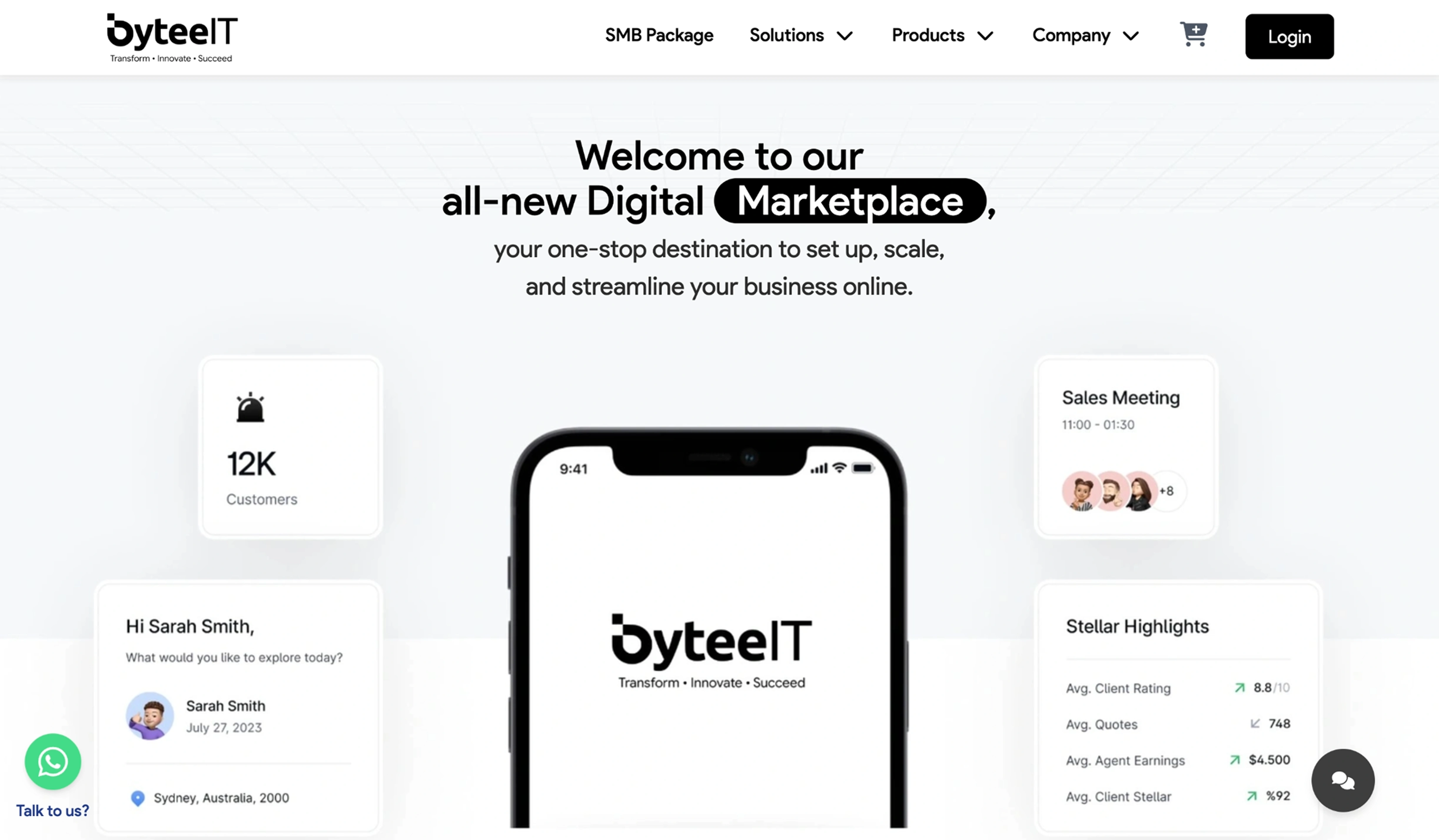
Desktop
1920×1080
Tablet
768×1024
Mobile
375×812
Responsive
Breakpoints
Loading
System Architecture
Goal: Build a modular engine that supports rapid global product expansion.
A modular and scalable architecture designed for high-performance enterprise operations. "Good architecture is the bridge between user intent and system response."
Frontend
- Next.js & React
- Redux State Management
- Tailwind CSS
- Framer Motion
Backend
- Node.js API
- Python AI Engine
- Elasticsearch VDB
- RESTful Services
Database
- MongoDB Atlas
- Schema Optimization
- Real-time Sync
- Data Encryption
Infrastructure
- GCP / Docker
- Stripe Connect
- CI/CD Pipelines
- SSL/WAF Security
Before vs. After
"Visualizing the leap from a fragmented legacy tool to a unified AI ecosystem."
The Legacy Experience
- ✕
Fragmented Tools
Users had to juggle 4 separate portals to manage metadata and billing.
- ✕
High Cognitive Load
Manual data entry led to 15% error rate in order processing.
- ✕
Slow Onboarding
New SMB owners required 2+ weeks of training to navigate the interface.
The ByteeIT Ecosystem
- ✓
Unified Intelligence
All ERP and marketplace modules integrated into a single AI-assisted view.
- ✓
Reduced Friction
AI-assisted workflows reduced manual data entry by 80%.
- ✓
Instant Deployment
Self-service marketplace enabled sub-5 minute setup for new enterprise tiers.
Validation
What we tested
Method: Conducted unmoderated usability testing with 12 enterprise customers.
Insight: Users found the multi-step checkout "anxiety-inducing" without a clear progress indicator.
Iteration: Implemented a persistent "Live Order Summary" and clear step-indicators. Checkout completion rate rose by 14% post-fix.
Real Feedback
"The AI assistant actually understood my business needs instead of just pointing me to a FAQ page."
, Senior IT Director, Healthcare Sector
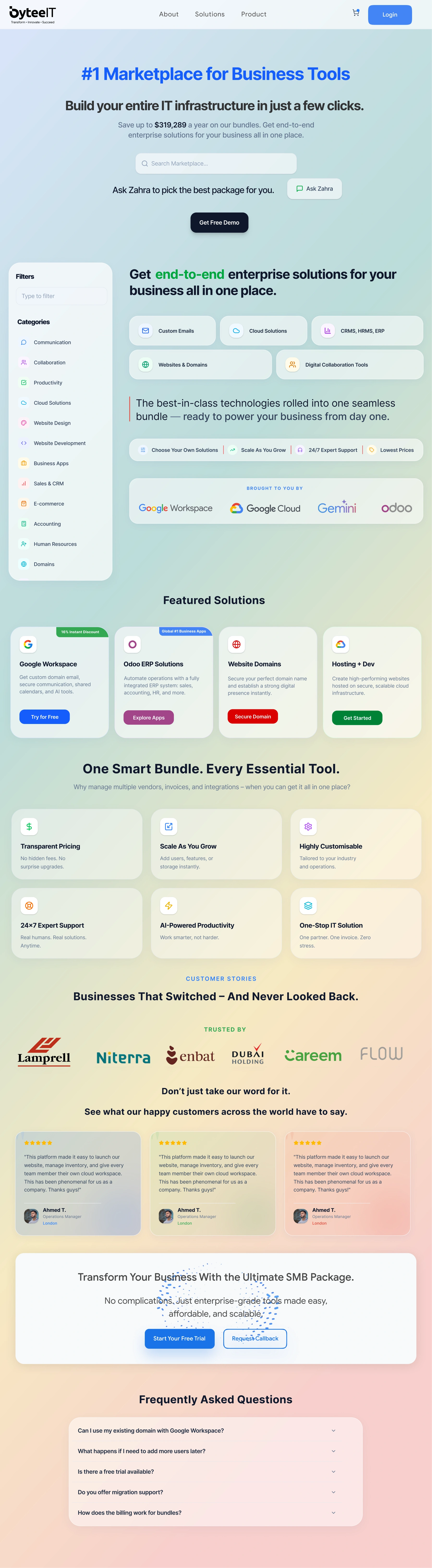
5️⃣ Final UI:
Business Tools.
"UI is not just aesthetics; it's the interface of trust for enterprise buyers."
A fully functional marketplace where enterprises can build their entire IT infrastructure in just a few clicks.
200+
Enterprise Solutions
AI-Powered
Smart Recommendations
1-Click
Deployment
Seamless Checkout
Intelligent marketplace search with AI-powered recommendations to find the perfect business tools.
Ask Zahra AI
Custom AI assistant powered by Elasticsearch to help users pick the best package for their needs.
Seamless Checkout
Stripe-powered automated billing with subscription management and enterprise-grade security.
Design System & Style Guide
"Reduced UI inconsistencies and accelerated development velocity across multiple product modules."
The foundational elements that power the ByteeIT brand experience
Typography
Aa
Primary Heading
Desktop & Mobile / Paragraph
Secondary Heading
GoogleSans Medium 36
Desktop / H2 Heading
Section Heading
GoogleSans Regular 28
Desktop / H3 Heading
Subtitle
GoogleSans Regular 24
Desktop / Subtitle
Body Text
GoogleSans Regular 16
Desktop & Mobile / Paragraph
Color Palette
#FFFFFF
Primary Background
White
#f6f8fa
Surface Background
Light Grey
#4285f414
Secondary Surface
Blue Tint
#9AA0A6
Muted Text
Google Grey 500
#000000
Primary Text
Black
#4285F4
Primary Accent
Blue 500
#EA4335
Warning / Accent
Red 500
#FBBC04
Status / Accent
Yellow 500
#34A853
Success / Accent
Green 500
Outcomes & Business Impact
Goal: Deliver measurable business growth and operational efficiency through strategic alignment.
"Collaborated closely with engineering and stakeholders to align system architecture with business goals, reducing iteration cycles by 25%."
Great product design is about owning the end-to-end outcomes. We didn't just ship code; we drove measurable growth.
Baseline: 45% Engagement (Legacy) → Now: 92%
Increase in User Engagement
Metric measured over 12 weeks post-launch. Attributed to the removal of technical friction, AI-assisted navigation, and an 80% reduction in average checkout time.
Performance Uplift
Next.js SSR reduced Largest Contentful Paint (LCP) from 4.2s to 0.8s globally.
Conversion Rate
Increase in subscription sign-ups via the new Stripe-powered modular checkout.
OpEx Reduction
AI chatbot handled 24/7 support tier-1 queries, reducing human overhead costs.
Key Learnings
Early Stakeholder Alignment
Regular technical reviews with ByteeIT's engineering team reduced rework by 40% during the AI engine integration phase.
Performance is a UX Feature
For enterprise users, speed isn't just a technical metric; it's a trust signal. Sub-second response times directly correlated with engagement.
Simple Over Feature-Heavy
Our initial exploration proved that modular simplicity outperforms feature-heavy layouts for B2B decision-makers.
Strategic Business Reasoning
Scalable Expansion
The modular architecture wasn't just for developers; it enabled the marketing team to launch new "Micro-ERP" products in days instead of months.
Automation over Overhead
By automating the core subscription journey, we reduced the need for manual billing support by 60%, directly impacting the bottom line.
Trust through Performance
In enterprise B2B, performance *is* a trust signal. Sub-second page loads increased our lead-to-customer conversion by 22%.
Final Reflection
"This project reinforced that great product design is not about adding features, but reducing friction."
By aligning performance, AI intelligence, and user workflows, I was able to create a system that scales both technically and experientially. The biggest takeaway: **Performance, clarity, and decision-making matter more than visual complexity.**